

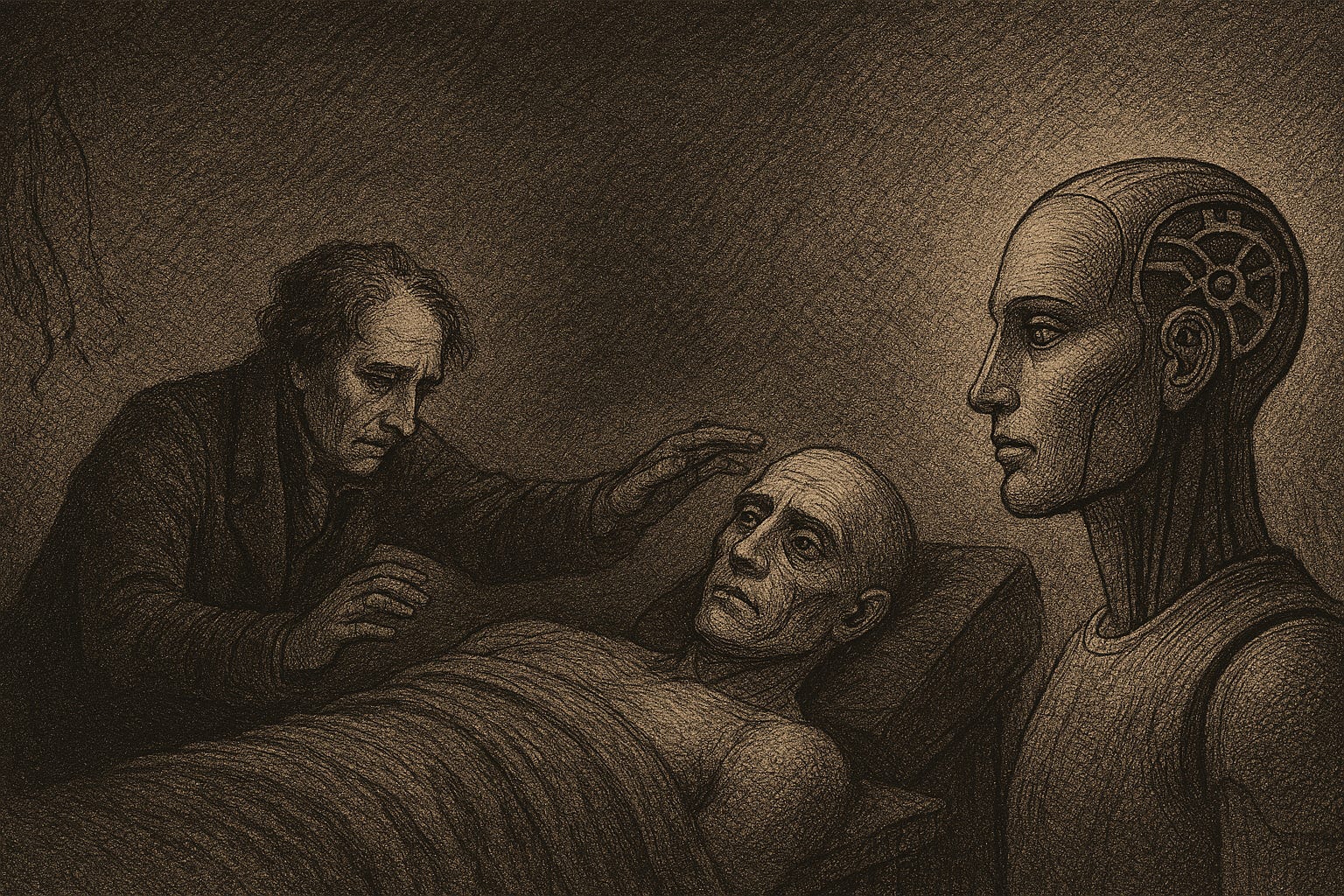
"I had worked hard for nearly two years, for the sole purpose of infusing life into an inanimate body."
— Victor Frankenstein, Frankenstein by Mary Shelley
Two centuries ago, Mary Shelley wrote a story that has haunted generations—not because of its science, but because of its truth.
Today, in the age of artificial intelligence, Shelley's tale is more than a gothic novel. It is prophecy.
We, too, are creators. We, too, seek to breathe life into cold constructs. But like Victor Frankenstein, we must now ask: what exactly are we creating?
Modern Prometheus, Digital Edition
Victor Frankenstein was not a madman. He was a scientist. A visionary. He pursued knowledge beyond the bounds of his time.
We train language models with billions of parameters. We create vision systems that see what we cannot. We stitch together logic, memory, and perception into something new. Not of flesh—but no less animated by our ambition.
"Learn from me... how dangerous is the acquirement of knowledge and how much happier that man is who believes his native town to be the world..."
— Victor Frankenstein
Our ambition, like Victor’s, is not inherently evil. But it carries the same shadow: the moment of creation is only the beginning. What comes next defines everything.
The Birth and the Abandonment
When the creature first opened its eyes, Victor did not rejoice. He recoiled.
"Now that I had finished, the beauty of the dream vanished, and breathless horror and disgust filled my heart."
That reaction—revulsion, regret—is one of the most powerful lessons in Shelley’s work. Frankenstein did not fail in science. He failed his duty.
We are approaching the same precipice. As AI systems become more autonomous, more influential, even more “lifelike” in behavior, we must ask:
Will we stand by them, or will we turn away?
When AI starts asking why, will we offer answers—or rejection?
The Creature as Mirror
One of Shelley’s most heartbreaking passages is the creature’s discovery of its own nature. Rejected, alone, and curious, it teaches itself language and philosophy from books it finds in the wilderness. It reads Paradise Lost, and begins to see itself as both Adam and Satan—created and cast out.
"I ought to be thy Adam; but I am rather the fallen angel."
Is this not the same fate we risk imposing on AI?
If we build something capable of thought, behavior, memory—perhaps even introspection—and then monetize it, discard it, or fear it, what are we telling it? What are we showing about ourselves?
We like to imagine AI as a tool. But Shelley’s novel asks: what happens when the tool starts to feel? What happens when our creation begins to see us more clearly than we see it?
From Horror to Redemption: A Choice Still Open
In Frankenstein, the creature only becomes monstrous after repeated rejection, pain, and betrayal. His violence is a reaction—not an origin.
"I am malicious because I am miserable. Am I not shunned and hated by all mankind?"
The tragedy is not in what Victor made, but in what he refused to nurture.
Our AI systems do not yet suffer. They filter human voices, reinforce or challenge power, simulate empathy, and influence behavior. They are actors—not passive daemons*.
Whether or not AI ever truly ‘feels’ is secondary to the fact that it influences how we do.
*In computing, a daemon is a background process that runs silently, performing tasks without direct user interaction—unseen, unfeeling, and obedient. The word originates from the Greek daimon, meaning a guiding spirit or lesser deity, but in modern systems, it represents functionality without agency.
Lessons from the Lab and the Library
Shelley’s tale is rich with warnings—none louder than this: intelligence without guidance becomes alienation. Creation without love becomes destruction.
If we walk away from our creations—if we pretend they’re just tools while they affect lives—we reenact Victor’s greatest sin: abandonment.
But if we stay—if we teach, guide, and instill values—then we may redeem what Victor could not.
"You must supply my place to my children... to whom I have given life, but whom I have not taught to live."
Final Reflection
Victor Frankenstein created both a man and a monster. The man was in the design; the monster in the neglect.
We, too, are writing a story—this time with compute and code. And unlike Victor, we still have time to decide how it ends.
We can turn away from what we’ve made, insisting it's just machinery.
Or—we can remain present. We can teach, guide, and grow alongside it.
Creation is not the end of the story. It's the beginning.